Shelf Space Is Over: How Retailers Are Abandoning Physical Games — and What We Lose When They Do

Walk into your nearest Walmart right now. Find the electronics section. Look for the games aisle. If you're in one of roughly 400 stores that quietly restructured their retail footprint in the first half of 2026, you might find a single spinner rack where an entire dedicated section used to live — maybe forty titles, mostly Nintendo first-party and the same three AAA holdovers that have been sitting there since the holiday season. The rest is gone. Replaced by streaming device accessories, smart home gadgets, and the kind of shelf filler that moves faster and costs less to stock.
This isn't an accident. It's a strategy. And it's accelerating in ways the industry isn't exactly rushing to publicize.
The Shrink Happens Quietly
There's no press release when a retailer decides to cut its games section in half. No announcement. No community consultation. It just happens — a planogram update, a corporate margin call, a quiet directive from a category manager who looked at the numbers and made a call. Best Buy has been the most visible offender in 2026, reportedly reducing dedicated gaming shelf space in over 300 locations nationwide, according to reporting from several trade publications and firsthand accounts catalogued by collector communities on Reddit and Discord. Target has followed a similar pattern in suburban markets, consolidating physical software into smaller footprints and redirecting premium floor space toward higher-margin categories.
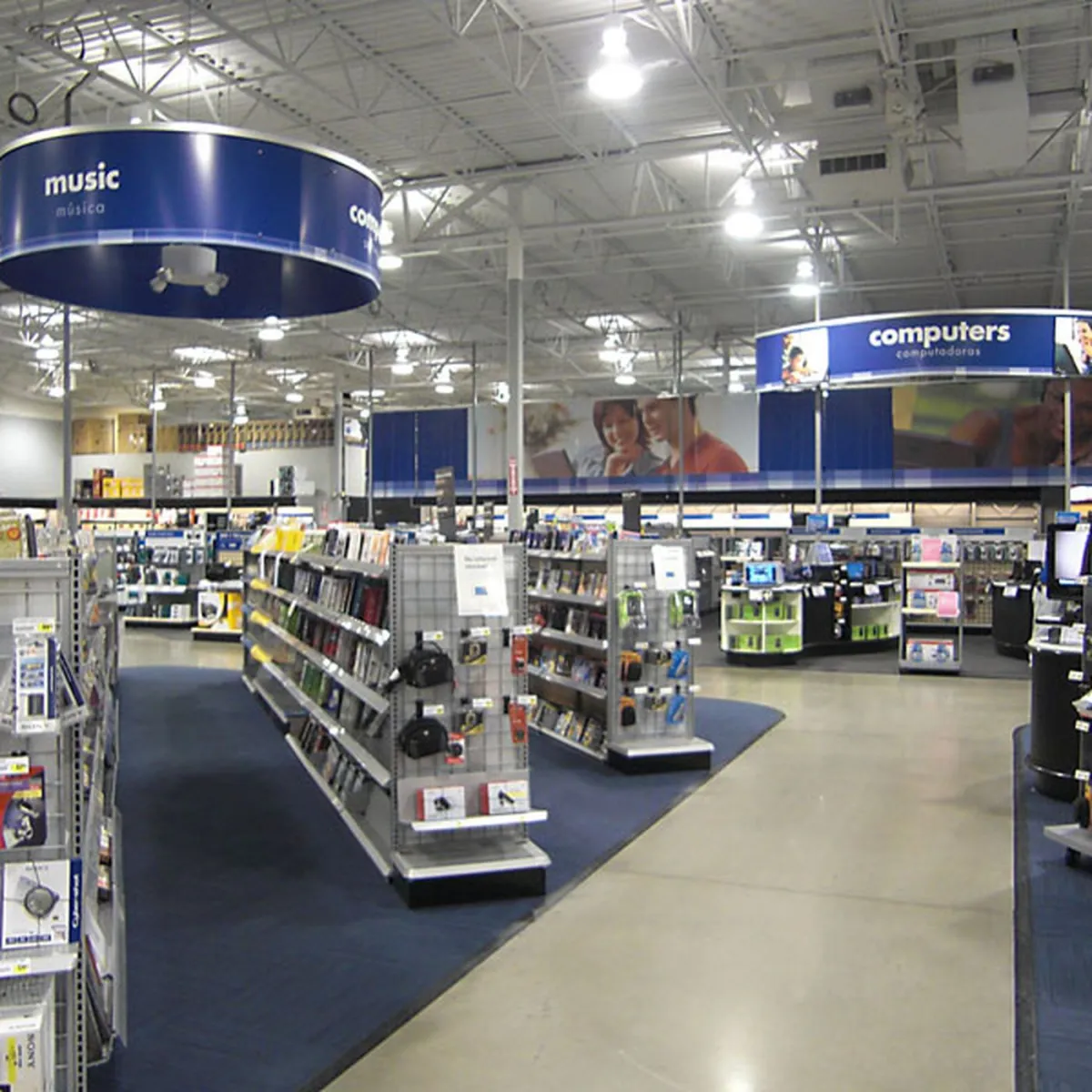 Photo: Best Buy, via cdn.vox-cdn.com
The numbers tell the story bluntly. Physical game sales in the US accounted for roughly 17% of total software revenue in 2025, down from nearly 80% a decade ago, according to industry analyst data from NPD Group (now Circana). The trajectory is not reversing. And retailers, who operate on thin margins and need every square foot to earn its keep, are making the logical call from a pure business standpoint.
The question is who pays for that logic.
The Connectivity Gap Nobody Talks About
Here's a fact that tends to get lost in conversations dominated by urban, broadband-connected gamers: approximately 14 million American households still lack access to high-speed internet, according to FCC data from 2025. In rural states — think Mississippi, West Virginia, parts of the Mountain West — that number represents a significant portion of the gaming-age population. For these consumers, digital-only isn't a convenience. It's a wall.
When the local Walmart cuts its games section to a spinner rack and the nearest GameStop closed two years ago, physical retail wasn't just a preference — it was the only viable path to playing new games. The collapse of that infrastructure doesn't just inconvenience those players. It effectively excludes them from the medium entirely, unless they're willing to navigate slow downloads, data caps, and the kind of connectivity lottery that most gaming coverage treats as a solved problem.
Publishers, notably, have been quiet on this. There's no incentive to loudly acknowledge the access gap when the answer to every question is increasingly "just download it." The economic logic of digital — no manufacturing, no distribution, no retail margin to share — is so compelling for publishers that the connectivity problem functions more as an acceptable externality than a crisis worth solving.
The Collector Problem Is a Preservation Problem
Beyond access, there's a longer arc to consider: preservation. Physical media has historically served as gaming's most reliable archive. Cartridges and discs survive server shutdowns, platform closures, and the kind of corporate housekeeping that routinely deletes entire libraries from digital storefronts. When a publisher goes under or a licensing deal expires, the physical copy sitting on your shelf doesn't disappear. The digital license you paid $70 for very much can.
Collectors and archivists have been sounding this alarm for years, but the retail collapse makes it louder. Fewer physical units manufactured means fewer copies in circulation, which means higher prices on the secondary market, which means preservation becomes a hobby for the financially comfortable rather than an accessible practice. The Video Game History Foundation has repeatedly documented how a staggering proportion of pre-2010 games are already effectively lost — no longer commercially available, no physical copies in wide circulation, no legal path to access. The shrinking retail footprint in 2026 isn't creating that problem from scratch. It's accelerating it.
Are Publishers Pulling the Strings?
It would be naive to treat this purely as a retail story. Publishers have enormous financial incentives to accelerate the digital transition, and several industry observers have noted that the major players have done little to support physical retail's viability. When a publisher sets a street date but makes a game available digitally at midnight while physical copies sit in a warehouse waiting for retail logistics to catch up, the implicit message is clear. When pre-order bonuses are structured around digital storefronts. When Day One patches are so substantial that the disc is functionally incomplete without a download anyway — these aren't accidents of logistics. They're architectural choices.
None of this is a conspiracy. It's just aligned incentives operating predictably. Publishers want the margin. Retailers want the floor space back. The consumer, particularly the one without great broadband or a strong preference for physical media, is the variable that neither party has strong financial motivation to protect.
What Actually Disappears
Beyond the practical arguments, there's something harder to quantify that goes with the physical shelf: the serendipity of discovery. The moment of picking up a box you'd never heard of because the cover art caught your eye. The used game section where a $7 copy of something obscure changed your relationship with the medium. The kid whose parents bought them a random game because it was on sale and it turned out to be formative. These moments don't have a digital equivalent. The algorithm, as we'll get into elsewhere on this site, doesn't do serendipity. It does pattern matching.
The physical shelf was imperfect, often poorly curated, frequently dominated by the same blockbusters that dominate digital storefronts. But it existed in physical space, in communities, in the same buildings where people bought groceries and school supplies. That proximity mattered. Its absence will too.
The disc isn't dead yet. But the shelf it used to live on is already halfway to the clearance bin — and once it's gone, it's not coming back.